
An ideal research group is simply
a handful of people who share the same curiosity, gathered together
on a mission
to continue a scientific story
that humanity can carry forward.
Our research aims to develop next-generation tissue-like soft semiconductor materials, devices, and systems for broad bioelectronic applications, such as human-centric wearable healthcare. We focus on semiconducting polymer PEDOT:PSS-based: 1) tissue-like soft organic bioelectronics and 2) tissue-like soft hydrogel bioelectronics. This focus stems from the fact that PEDOT:PSS is a typical organic mixed ion-electron conductor (OMIEC) and is considered the “silicon” material in organic bioelectronics due to its exceptional overall properties.
We pursue fundamental research and engineering in this direction to address the community’s most difficult challenges in designing, assembling, and interfacing PEDOT:PSS bioelectronics for medicine and biological systems. In doing so, we create new knowledge and push the boundaries of the discipline, ultimately contributing to life improvement.
Research work in our laboratory is generously supported by:
External Grants
Fundamental research
NSFC YSF (Type A) 2026
RGC ECS 2024/2025 (PI)
RGC CRF (YCRG) 2023/24 (PC); CRF 2025/26 (Co-PI)
RGC GRF 2022/23 (PI) 2025/26 (PI)
RGC Germany/HK JFS 2022/23 (PI)
RGC PDFS 2022/2023 (Supervisor)
RGC TRS 2022/2023 (Co-I)
Applied research
MOST-ITC MHKJFS 2021/2022 (PC)
Shenzhen STI (Type C) 2021/2022 (PC)
HKSI SRFS 2022/2023 (Co-PI)
Internal Grants
HKU SIRS 2022 (PI)
HKU Small Equipment Grant 2021 (PI)
HKU Innovation Wing 2021 (PI)
PC for Project Coordinator; PI for Principal Investigator; Co-I for Co-Investigator
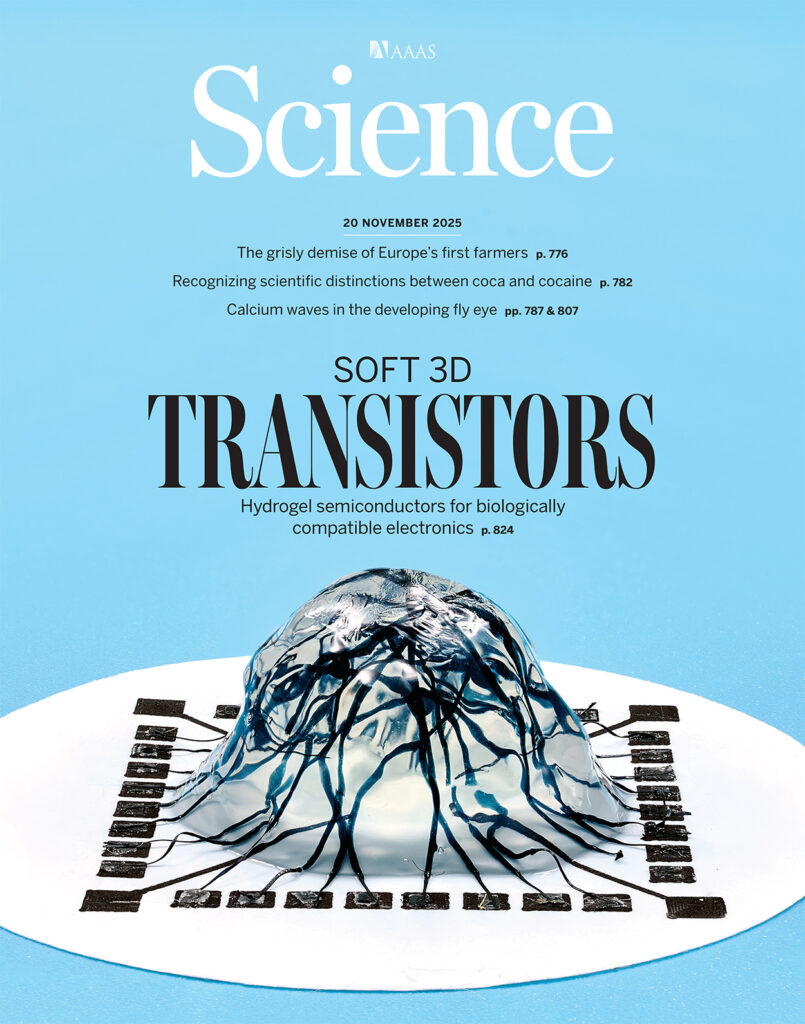
1. Hydrogel engineering for tissue-integratable biosensing and biocomputing
The invention of 3D semiconductor technology: Transistors, fundamental to modern electronics, are traditionally rigid, planar, and two-dimensional (2D), limiting their integration with the soft, irregular, and three-dimensional (3D) nature of biological systems. Here, we report 3D semiconductors, integrating organic electronics, soft matter, and electrochemistry. These 3D semiconductors, in the form of hydrogels, realize millimeter-scale modulation thickness while achieving tissue-like softness and biocompatibility. This breakthrough in modulation thickness is enabled by a templated double-network hydrogel system, where a secondary porous hydrogel guides the 3D assembly of a primary redox-active conducting hydrogel. We demonstrate that these 3D semiconductors enable the exclusive fabrication of 3D spatially interpenetrated transistors that mimic real neuronal connections. This work bridges the gap between 2D electronics and 3D living systems, paving the way for advanced bioelectronics systems such as biohybrid sensing and neuromorphic computing.
Read more: Science.

The invention of hydrogel semiconductor: The realization of hydrogel-based transistors holds significant promise for the development of tissue-integratable biologics by addressing the modulus mismatch with living systems. However, their development faces notable challenges, primarily due to the thin-film nature of semiconductors, which are typically less than 1 micrometer thick. In contrast, hydrogels tend to have greater thicknesses and struggle to exhibit semiconductor properties. In our experiments, we observed semiconducting behavior from a purposely designed nanocomposited, multi-network hydrogel at certain thicknesses up to 10 µm. However, the on/off switching ratio remains poor compared to their thin-film counterparts, highlighting both the challenges and the potential of these materials to advance future soft bioelectronics.
Read more: Advanced Materials, MRS Symposium.

2. Tissue-like organic bioelectronics (materials, physics, fabrication)
The invention of stretchable organic electrochemical transistor: OECT is a flagship technology among organic bioelectronic devices. It is considered as the perfect link between biology and microelectronics considering the property similarities at large. However, the mechanical mismatch at the biotic-abiotic interface causes stability issues. Here, we develop tissue-like stretchable and healable OECTs to facilitate their interfacing with soft tissues by materials development and device engineering.
Read more: Chemistry of Materials, Advanced Science, Advanced Electronic Materisals, Advanced Functional Materials, Journal of Materials Chemistry C, Applied Physics Letters.

3. Fully-integrated wearable system: sense, compute, control
Multi-modal biowearable systems: Despite the significant potential of organic/hydrogel bioelectronics for conformable human-centric healthcare applications, the absence of a compact readout platform impairs wearability of the entire system. We developed the PERfECT readout platform—a coin-sized, low-power, and multiplexed unit designed for wearable analysis of organic/hydrogel electrodes and biotransistors. Here, we develop multi-modal biowearable systems capable of revealing health parameters that cannot be discerned with a single parameter alone. Simultaneously, we develop closed-loop biowearables for sensor-controlled automatic medicine, such as glucose sensing and insulin injection.
Read more: Nature Electronics, Science Advances, Analytical Chemistry, Nature, IEEE Electron Device Lett., AllAboutCircuits, Animation of sensing.
Funded by:
▪️ Innovation and Technology Commission (ITC), Mainland-Hong Kong Joint Funding Scheme (National Key R&D Program, 國家重點研發計劃).
▪️ Shenzhen Science and Technology Innovation Committee (SZSTI) Shenzhen-Hong Kong-Macau Science and Technology Program (Type C).
▪️ University Grants Committee Theme-based Research Scheme.

Wearables for AI, AI for Wearables
In our recent work published in Nature Electronics, we developed a system that exemplifies the concept of “Wearables for AI, AI for Wearables”:
Wearables for AI:
- We develop stretchable OECTs to collect high-quality data, minimizing motion artifacts.
- The data is processed in situ using OECT arrays with an algorithm called reservoir computing, which improves power efficiency by projecting the raw data into a high-dimensional space.
AI for Wearables:
- The high-dimensional data is subsequently used for training on a computer, where the hidden layer weights are learned.
- These trained weights are then implemented back into the wearable system for real-time data interpretation.
Our approach demonstrates: 1) how wearable sensors can drive advancements in AI-healthcare; and 2) how AI enhances the capabilities of wearables.